

Application Security Tools Compared: Why Modern AppSec Teams Move Beyond Static Scanners
Compare runtime-validated AppSec against the static scanners, developer-native platforms, and AI code review tools you already evaluate. See where Kodem fits across SAST, SCA, container security, and runtime defense. Pick a vendor comparison below or scan the capability matrix.
Trusted by










Compare Kodem to your current application security tool
Kodem brings an end to false positives and wasteful manual labor, leading your security and dev teams to only take meaningful action that heightens security.
Kodem vs Snyk
Replace static dependency scanning with runtime call graph validation and Attack-Driven Remediation.
Kodem vs Snyk
Replace static dependency scanning with runtime call graph validation and Attack-Driven Remediation.
Kodem vs Snyk
Replace static dependency scanning with runtime call graph validation and Attack-Driven Remediation.
Kodem vs Snyk
Replace static dependency scanning with runtime call graph validation and Attack-Driven Remediation.
Kodem vs Snyk
Replace static dependency scanning with runtime call graph validation and Attack-Driven Remediation.
Kodem vs Snyk
Replace static dependency scanning with runtime call graph validation and Attack-Driven Remediation.
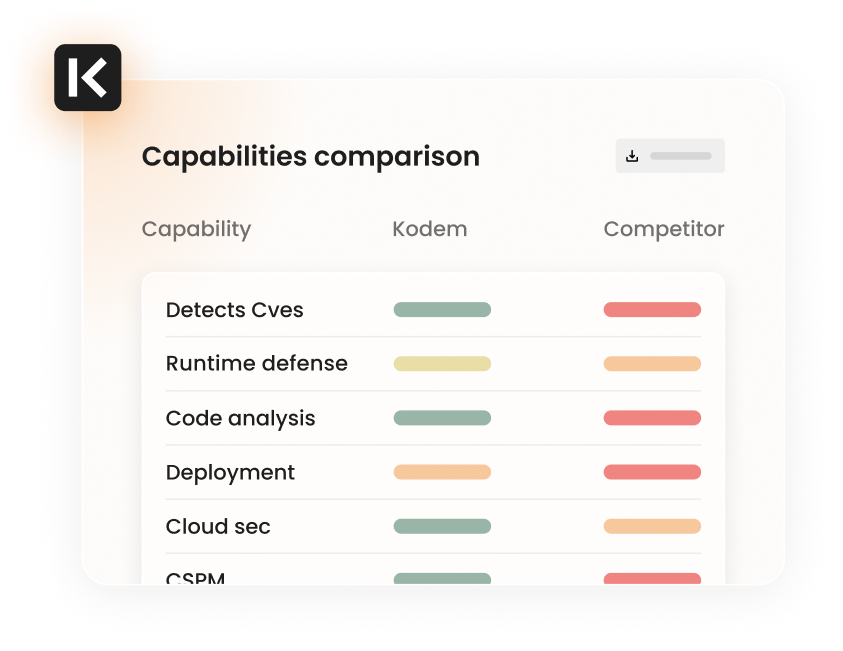
Capability comparison:
Kodem vs every mode
Kodem brings an end to false positives and wasteful manual labor, leading your security and dev teams to only take meaningful action that heightens security.

What is runtime application security?
Runtime application security is the practice of validating which vulnerabilities are actually exploitable in a running application, and defending against exploitation in real time rather than waiting for upstream patches.
It combines static analysis with runtime telemetry to build accurate call graphs of what code executes, where untrusted input flows, and which vulnerable functions are reachable. Modern runtime application security tools add Attack-Driven
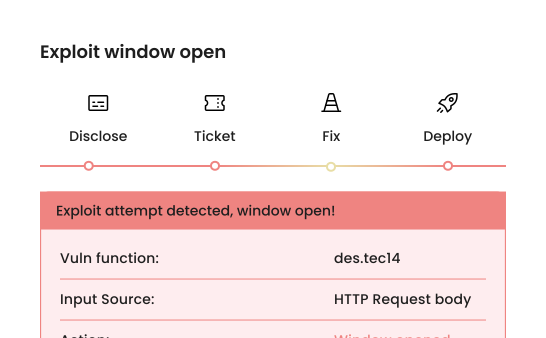
Remediation, runtime policies that intercept exploit attempts at the kernel level. The result: false positives drop, mean time to remediation drops, and exploit windows close before code is patched.

Reviewed by Pavel Furman
Co-founder & CTO, Kodem
.png)


Why current application security tools produce more noise than action
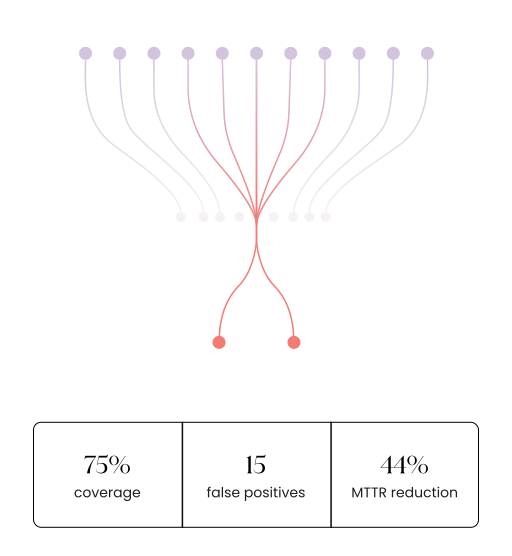
Modern AppSec stacks generate thousands of findings. Static analysis (SAST and SCA) and developer-first scanning tools produce long lists of potential issues but provide little context or evidence of exploitability. They suffer from five compounding failures:
No runtime context
Tools cannot confirm that a vulnerable function is ever invoked, or whether the environment exposes it to untrusted input.
No zero-day coverage
Reliance on CVE databases leaves unknown vulnerabilities undetected until disclosure.
Conservative call graphs
Static analyses approximate control flow, leading to false positives and high triage overhead.
Conservative call graphs
Static analyses approximate control flow, leading to false positives and high triage overhead.
Conservative call graphs
Static analyses approximate control flow, leading to false positives and high triage overhead.
Security teams are overwhelmed not by a lack of signal, but by a lack of certainty and control.
How Kodem works: runtime validation plus ADR
Kodem operates on a different plane. Instead of instrumenting your code, it deploys lightweight eBPF sensors at the operating-system level. These sensors collect runtime call graphs across languages, frameworks, and services without modifying application code or libraries. They observe system calls, network I/O, and file operations to build a complete picture of execution and data flow. They correlate static and runtime context, connecting vulnerable source and dependency code to actual execution paths.
On top of this telemetry, Kodem employs generative AI trained on real execution traces. The AI performs taint analysis to track untrusted inputs, detects anomalous patterns that signal zero-day exploits, and generates runtime patches (ADR policies) expressed as eBPF rules that intercept unsafe calls before exploit payloads execute.
No runtime context
Tools cannot confirm that a vulnerable function is ever invoked, or whether the environment exposes it to untrusted input.
Cross-language and polyglot support
Monitors Java, .NET, Go, Rust, Node.js, Python, C/C++, and interpreted languages uniformly.
Deep dependency analysis
Inspects source and binary dependencies, including pre-compiled native libraries and OS packages.
Generative AI for exploit validation
Merges static and dynamic signals to rank vulnerabilities by exploitability, eliminating dead-code alerts.
Zero-day detection
Identifies suspicious call sequences and behaviours (unsafe deserialization, reflective invocation) even before a CVE is published.
Attack-Driven Remediation (ADR)
Synthesizes runtime policies that intercept unsafe calls, block injection payloads, and enforce safe defaults without touching application code.
Real-time telemetry
Feeds continuous call-graph data into a graph database for correlation, query, and forensic analysis.
CI/CD and production-resident
Runs as a gating step in CI and remains active in production, protecting the exploit surface from dev through deployment.
Why traditional models fall short
| Model | Core Mechanism | Technical Limitations |
|---|---|---|
| Static analysis (SAST & SCA) | Cannot observe runtime behaviour. Conservative reachability leads to false positives. Lacks insight into compiled dependencies and dynamic loading. | Cannot observe runtime behaviour. Conservative reachability leads to false positives. Lacks insight into compiled dependencies and dynamic loading. |
| Developer-native scanning | Integrates SCA and SAST into CI/CD pipelines and IDEs | Same static limitations. Only sees what is in the repository. Cannot observe library calls, system interactions, or container images at runtime. |
| AI code review tools | Large language models reason about code patterns and suggest fixes | Limited by training data. Cannot verify that vulnerable code executes. No visibility into runtime or compiled dependencies. No defense. |
| WAF, EDR, and NDR | Inspect network and host traffic | See only network packets or process behaviour. Cannot correlate to function-level execution or code context. High false positives. Cannot auto-patch vulnerabilities. |
|
Hybrid static + runtime call-graph collection (eBPF) with AI-driven taint analysis and ADR | Unifies and extends the four approaches above. Covers code, dependencies, containers, and runtime. Validates exploitability. Models attack chains. Enforces protection. |
How Kodem works: runtime validation plus ADR
Kodem operates on a different plane. Instead of instrumenting your code, it deploys lightweight eBPF sensors at the operating-system level. These sensors collect runtime call graphs across languages, frameworks, and services without modifying application code or libraries. They observe system calls, network I/O, and file operations to build a complete picture of execution and data flow. They correlate static and runtime context, connecting vulnerable source and dependency code to actual execution paths.
On top of this telemetry, Kodem employs generative AI trained on real execution traces. The AI performs taint analysis to track untrusted inputs, detects anomalous patterns that signal zero-day exploits, and generates runtime patches (ADR policies) expressed as eBPF rules that intercept unsafe calls before exploit payloads execute.
CVE-2021-44228
No runtime context
Static scanners flagged every use of Log4j, forcing emergency upgrades across thousands of services. Kodem traced runtime call graphs and saw that many services never invoked the vulnerable JndiLookup.lookup() call. It downgraded those alerts and prevented unnecessary patching.
In services where the call did occur, Kodem's ADR injected an eBPF policy that intercepted the JNDI lookup and blocked remote code loading. Exploits were neutralized while the library was patched in the background.
Cross-language and polyglot support
Monitors Java, .NET, Go, Rust, Node.js, Python, C/C++, and interpreted languages uniformly.