.svg)
SCA Security Tools
Know which packages are actually exploitable, in your environment
Kodem goes beyond traditional software composition analysis by connecting vulnerable packages to real runtime context. We show you which dependencies are loaded, executed, and attacker-reachable, so you can prioritize what’s truly at risk in production, not just what’s listed in a manifest.

“Kodem harnesses its unparalleled runtime expertise to release one of the strongest SAST offerings in the market. Finally, we can get real results, with virtually no false positives”

Runtime SCA, Explained
What is SCA Security?
Software Composition Analysis (SCA) security is the practice of identifying, tracking, and prioritizing vulnerabilities in the open-source and third-party components your applications depend on. Modern software is built on a foundation of open-source packages. A typical codebase is 70 to 90 percent third-party code, which means most of your attack surface lives in dependencies you did not write.
The Problem
Legacy SCA Security tools work in silos. Attackers don’t.
Most tools analyze code, containers, or infrastructure in isolation, missing how real attacks span layers. Without unified context, teams are left with blind spots, false positives, and no sense of what’s truly exploitable.
The Solution
Kodem unifies SCA security with the full application stack to surface real risk.
From source code to containers and runtime behavior, Kodem connects the dots across your environment. We show you which vulnerabilities are active, exploitable, and matter most, so your team can focus on what attackers can actually reach and run.

Full-Stack Visibility
See the whole system, not just a slice
Kodem analyzes code, libraries, containers, and infrastructure together, surfacing cross-layer issues and attack paths that siloed tools miss.

Runtime-Aware Detection
Know which vulnerable functions actually run
We trace function-level execution to highlight which CVEs are live in production. You stop fixing unused code and start fixing real exposure.

Attack Chain Mapping
Break the chain before it breaks you
Kodem models how attackers can link multiple vulnerabilities across layers into a real exploit path, so you can block the full kill chain, not just one bug.

Environment-Specific Exploitability
Fix what’s exploitable in your environment
We factor in runtime behavior, network exposure, and deployment stage, so you know exactly which vulnerabilities can be exploited in your stack, not just in theory.
Runtime SCA vs Static SCA vs DAST
Three common approaches to finding open-source risk. Only one ties vulnerabilities to what is actually running in your environment.
"Our solution redefines code security by merging SCA, SAST, and ADR into one accurate, high-performing platform."

"Kodem's platform offers one of the strongest solutions available, delivering real-world results with virtually no false positives."


Identify vulnerable packages actually in use at runtime

See which dependencies are attacker-reachable

Prioritize CVEs based on real exploitability in your environment

Generate fixes for vulnerabilities without known patches

Runtime-powered SCA
:
What to Know
SCA security, short for Software Composition Analysis security, is the process of finding and managing vulnerabilities in the open-source and third-party packages used in your applications. A modern SCA security platform tracks every direct and transitive dependency, maps each one to known CVEs, and tells you which of those vulnerabilities are actually reachable in your environment.
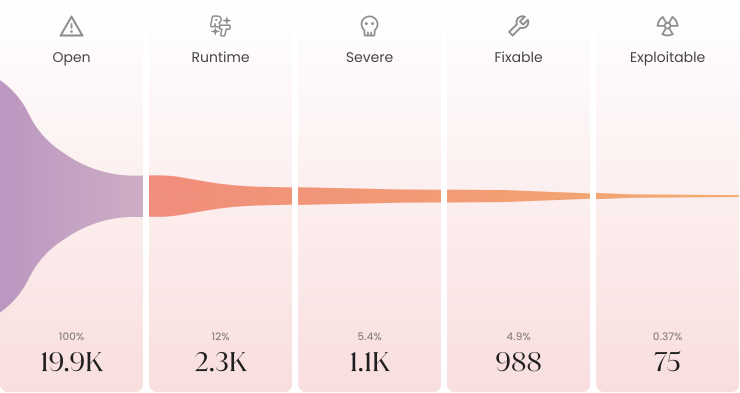
Static SCA scans your package manifest (package.json, pom.xml, requirements.txt, and similar) and flags every CVE in every declared dependency. Runtime SCA goes further. It traces which packages are actually loaded into memory and which functions are executed during production workloads. Runtime SCA eliminates vulnerabilities in code that never runs, which can cut false positives by 90 percent or more.
Reachability analysis determines whether a vulnerable function in a dependency is actually invoked by your application code. A CVE in an unreached function poses no real risk. Kodem’s reachability analysis combines static call graph mapping with runtime execution data, so your team only triages vulnerabilities that attackers can actually exploit.
Transitive dependencies are the packages that your direct dependencies rely on. A single npm install can pull in hundreds of transitive packages, and most open-source vulnerabilities live in transitive code. A strong SCA security tool maps the full dependency tree, including OS-level and container packages, so nothing hides from view.
Yes. Kodem produces a continuously updated Software Bill of Materials (SBOM) in standard CycloneDX and SPDX formats, covering application libraries, container layers, and OS packages. The SBOM is enriched with runtime execution data, so you can show auditors not just what is installed, but what is actually running in production.
Kodem supports cloud-native environments including Kubernetes, container, virtual machines, and hypervisors. It also runs in air-gapped environments. The external analyzer plus in-host sensor architecture means Kodem works across CI/CD, staging, and production without adding significant overhead.
Legacy SCA tools rank vulnerabilities by CVSS score and dependency declaration. They produce findings without context. Kodem ranks vulnerabilities by runtime exploitability, asking: is the vulnerable function loaded, is it executed, is the call path attacker-reachable, and is the exposure present in your specific environment? That context-aware model is what reduces triage workload by up to 99.5 percent.